At some point, someone's going to accuse me of being formulaic. How exactly is that different from studying what's worked for other writers? Not sure, but just to forestall any argument, let me tell you this -- templates are a place to start. Not the final product. Feel free to break the rules once you know them well enough to do so successfully.
Writing is rewriting. Lists, checklists, templates -- all gleaned wisdom, a place to start so you're not staring at a blank page. Want to argue about it? Fine, carry on. I'll listen to you when you've had ten or more books published.
Back to the template -- I say again for possible penetration -- this is a place to start. Here's how I might structure the first few paragraphs using an action hook.
FIRST PARA
Sentence one: Hook
Sentence two: Set world.
Sentence three: Set story
The bomb ticked. Nothing else made a sound inside the aircraft. It was up to
me to stop it.
First Sentence: At my last advanced fiction class, we compiled a list of
“we’re THERE” words. Nazis. Nuclear. Blue Pigs. Any of those will work.
I’m being a little facetious with that, but not entirely. You’ve got to have a
killer hooking word in that first sentence. Remember, your first readers are
editors and agents, people who see lots of first sentences. Yours must be
solid gold.
Second Sentence: Note that the important part in the second line is not the
silence – it’s the way it establishes that we’re inside an aircraft. I could also
have done something like, “The Boeing Sky Eagle plowed through the sky at
thirty-one thousand feet.” That also puts us inside an aircraft.
Third sentence: Here we establish that we’re in first person and sets up the
fact that it’s written in first person. This works but if you can get that first
person fact into the very first sentence, that’s even better. (We’re going to
deal with some first person POV issues in a later section.)
REMEMBER -- no matter how you structure this, you must always be aware of your distance from the reader. More on that later. Remind me if needed because it's a critically-misunderstood part of POV.
Sunday, July 18, 2010

Missing in Action
Where have I been and why is this blog not updated? Good question. Here's the short version -- I may or may not get around to posting the longer story.
Let it suffice to say that on 1 June 2010, at Vanderbilt University Medical Center, I had surgery to remove a golf ball-sized tumor on my pituitary gland. Recovery has been uneventful but slow. Benign, slow-growing, but probably has been affecting me for some time.
Now I'm back. Stay tuned.
Let it suffice to say that on 1 June 2010, at Vanderbilt University Medical Center, I had surgery to remove a golf ball-sized tumor on my pituitary gland. Recovery has been uneventful but slow. Benign, slow-growing, but probably has been affecting me for some time.
Now I'm back. Stay tuned.
Sunday, January 10, 2010
Five trends writers should watch.
In no particular order, here's what I'm watching this year:
1. Blurring between reality and fiction.
1. Blurring between reality and fiction.
2. Big surprise -- digital.
3. Filters: publishing houses or fans?
4. Bestseller: says who? Will it matter any more?
5. Published -- death by overuse.
1. Blurring between reality and fiction.
Creative nonfiction. Warcraft. Facebook and Twitter. Expect the traditional lines between fiction/nonfiction/reality to continue to blur. Writers who understand how to capitalize on this trend will score big.
2. Big surprise -- digital.
Most of the major studies predicted increased popularity of ebooks and other digital media. Even with the less-than-impressive Kindle formats and even-less-impressive price, the popularity of digital media is breaking all expectations.
3. Filters: publishing houses or fans?
I'm going out on a contrarian limb here and say that readers have never really cared who the publisher of a book is. The only major exception has been on the far ends of the spectrum -- Harlequin and Knopf, for instance. But Random House or Putnam? No, most readers don't know or care.
But with the masses of crap flooding the market these days, eventually a filter will emerge. Will readers start noticing who publishes what and automatically dismiss the iUniverse, PublishAmerican and ExLibris imprints? Or will third party citizen reviewers emerge as the gatekeepers? It's an excellent chance for a publisher to jump into the gap, but none have so far.
4. Bestseller: says who? Will it matter any more?
It used to matter. Still does in some circles. But not as much as when "traditional" publishing dominated the market. Every Tom, Bill and Penny is watching amazon.com rankings within a particular sub-sub category and immediately crowing over "bestseller" status when the rank breaks 1,000,000.
5. Published -- death by overuse.
Same thing with the term "published author". Tom, Bill and Penny can all be "published" simply by forking over the required fees and filling in the blanks on a template cover. I've got news for you: that doesn't count. Or at least it didn't. Nowadays, the wise consumer asks, "Published by WHOM?" before accepting the self-proclaim "published author" at face value.
Tuesday, December 15, 2009
Booksurge merges with Createspace
I have to say, Createspace.com makes it very easy to put content into print. In today's world, is that what publishing is about? We need to take a serious look at what a book is and how we define the process of moving content out of our minds -- and off our desks -- and into the rest of the world.
Tuesday, August 18, 2009
How publishers calculate a novelist's advance
Cover price x advance orders x royalty rate x 1.3 x .5 x.6 = advance
For those of you who have number phobias, read on to find out how it all works:
The publisher gets advance orders. Say advance orders on this hardcover at 4,000 books. The publisher will often order a multiple of that number, the third factor in the above formula. If the order multiplier is 1.3, we end up with an initial print run of 5,200 books. If the hardcover is priced at $22, that's a potential gross of $114,400. The author's royalties would be approximately ten percent of that, or $11,440.
But wait. That's if the publisher sold every copy and that just doesn't happen.
Bookstores and distributors order book essentially on consignment. They've got a year to return the books for full credit. Hardcovers they actually ship back. Paperbacks, they just strip the cover off and mail that back. That's why you'll see that notice in the front sometimes about, "If you bought this book without a cover."
Sell-through is the term used to define what percentage of a print run is actually sold to consumers. A good, STRONG sell-through is 50%. In this case, that would be 2,600 books, or net royalties of $5,700.
So that's what you'll get, right? Nope. There's more.
Fifty percent is a GOOD sell-through. You might have a lousy sell-through.
To allow for that possibility, you're not going to get that entire $5,700. The publisher has some percentage of that that is policy. If, for instance, policy is 60%, you'll get an advance of $3,420.
I ran this by one of my editors and here's his response:
Your formula is sensible and in the ball park, although smaller publishers need a higher sell-through than larger publishers. There are two factors you didn't include, however. Let's say that the advance as calculated should be $3,420. The publishing director or business manager will press the editor to be conservative and offer an advance of, say, $2,500. The author's agent will likewise press the editor to offer an advance of $5,000, feeling that the extra cash up front will force the publisher to spend more money on marketing and publicity, in order to ensure recouping the advance. That doesn't necessarily happen, of course, but that's the way agents think. And agents would rather have their percentage up front, anyway. And then there is the pernicious practice of some publishers of holding some of the royalties back from the author as a reserve.
Monday, July 6, 2009
Just Released: The Black Belt Guide to Internet Presence
Well-trained martial artists concentrate on efficient and powerful moves. No telegraphing, no extraneous movements. Minimum effort for maximum effect.
The Black Belt Guide to Internet Presence will show you how to get the maximum return for the minimal expenditure of your time and talent.
This is what you’re going to do:
Sounds easy, eh? But the ins and outs of how exactly to wire it all are not all that obvious.
You probably already know what Facebook, Twitter, MySpace, LinkedIn, and a few other social media destinations are. You may even have accounts with one of or all of them. If not, don’t worry. They’re very easy to set up.
I focused particularly on writers who want to sell books, so you’ll see a few references to readers and writers and publishing. But this system will work for any subject/cause/ business/obsession. Just substitute the word “clients” when I say readers and “your industry” when I say publishing.
So, if you’re ready for the down and dirty on establishing your internet presence, check out the Black Belt Guide to Internet Presence. Click here!
The Black Belt Guide to Internet Presence will show you how to get the maximum return for the minimal expenditure of your time and talent.
This is what you’re going to do:
- Set up a blog
- Write a series of notes
- Schedule the posts
- Cross-connect it all
Sounds easy, eh? But the ins and outs of how exactly to wire it all are not all that obvious.
You probably already know what Facebook, Twitter, MySpace, LinkedIn, and a few other social media destinations are. You may even have accounts with one of or all of them. If not, don’t worry. They’re very easy to set up.
I focused particularly on writers who want to sell books, so you’ll see a few references to readers and writers and publishing. But this system will work for any subject/cause/ business/obsession. Just substitute the word “clients” when I say readers and “your industry” when I say publishing.
So, if you’re ready for the down and dirty on establishing your internet presence, check out the Black Belt Guide to Internet Presence. Click here!
Thursday, July 2, 2009
If you don't take it seriously, no one else will
An egomaniac with an inferiority complex: sound familiar?
If that glove feels just a little too much like it fits, then congratulations -- you're probably a fairly decent writer. Learn to live with the cognitive dissonance because it's gonna be around for a long time.
It's when the two opposites get out of balance that you'll run into problems. If you believe you cannot be taught, that you are GOOD and you don't NEED any editing or feedback or to progress -- you're out of balance. EVERYONE can get better. EVERYONE. Get teachable.
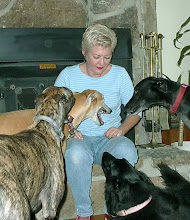
Conversely, if you subordinate your talent to other's needs too often, the Muse will poop on your paper. Muse poop, much like Greyhound poop, is not a good thing. I mean, you could stretch this analogy to the breaking point and talk about how it's good to poop on paper as opposed to the porch or the ungrouted new tile floor in the fireplace room, but seriously -- poop on paper that should contain brilliance is generally bad.
Take your writing seriously. Take yourself and your talent seriously. Humbly, but seriously.
And don't listen to nonwriters who think this is nonsense. If you're a writer, you know what I'm talking about.
If that glove feels just a little too much like it fits, then congratulations -- you're probably a fairly decent writer. Learn to live with the cognitive dissonance because it's gonna be around for a long time.
It's when the two opposites get out of balance that you'll run into problems. If you believe you cannot be taught, that you are GOOD and you don't NEED any editing or feedback or to progress -- you're out of balance. EVERYONE can get better. EVERYONE. Get teachable.
Conversely, if you subordinate your talent to other's needs too often, the Muse will poop on your paper. Muse poop, much like Greyhound poop, is not a good thing. I mean, you could stretch this analogy to the breaking point and talk about how it's good to poop on paper as opposed to the porch or the ungrouted new tile floor in the fireplace room, but seriously -- poop on paper that should contain brilliance is generally bad.
Take your writing seriously. Take yourself and your talent seriously. Humbly, but seriously.
And don't listen to nonwriters who think this is nonsense. If you're a writer, you know what I'm talking about.
Subscribe to:
Posts (Atom)